Human-caused sea level rise drives rapid global increase in extreme water levels during 21st century, new research finds
PR Newswire
PRINCETON, N.J., June 10, 2026
Climate Central-led paper finds climate change tripled the number of days with extreme water-levels at worldwide locations since the 1970s.
PRINCETON, N.J., June 10, 2026 /PRNewswire/ — As sea level rise accelerates, more and more people, ecosystems, and infrastructure are facing increasing coastal flood risks globally. Until now, climate change’s influence on local and regional flood risks has been underexplored, leaving communities without vital information they need. Now, a new paper led by Climate Central helps pinpoint how much human-caused climate change is responsible for increases in extreme water levels at local and regional scales across the globe.
The new research published in Science Advances finds that human-caused sea level rise is detectable at 97% of global tide gauge sites investigated and climate change was responsible for 58% of the observed days with extreme water levels during 2000-2018. Averaged across all locations, climate change has nearly tripled the number of days exceeding extreme water level thresholds since the 1970s.
“These studies highlight how we’ve loaded the climate dice against not only our children and grandchildren, but ourselves!” said Daniel Gilford, paper author and climate scientist at Climate Central. “The effects of human-caused climate change are already here. We will continue to face growing threats like increasing coastal flood risks unless we immediately and sharply reduce our climate pollution.”
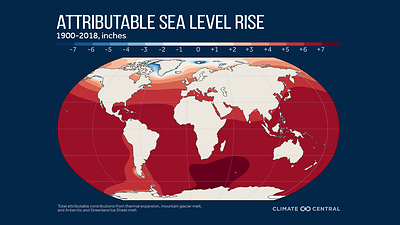
Climate Central researchers used two largely independent methods to estimate the climate change signal in sea level rise and extreme water levels at 519 tide gauge sites around the world. Results from the first method were determined by calculating attributable sea level rise from four contributing factors: thermal expansion of water, melt from mountain glaciers, and ice loss from Greenland and Antarctica ice sheets.
The second method compared observed sea levels from 1900-2018 to a modeled scenario of the same period but without the influence of climate-warming pollution. Similar conclusions from both methods give confidence in the overall findings — human-caused sea level rise is responsible for driving the majority of extreme water levels worldwide.
These results are further supported by the findings in a complementary new paper in Nature Climate Change by researchers from Tulane University, titled, “Human-driven sea-level rise has quadrupled the frequency of coastal sea-level extremes since 1900“, released concurrently with this work. For more on that paper, please see the Tulane University press release located here.
“Sea level rise is making both tidal flooding and storm-driven flooding more frequent, extensive and expensive,” said Robert Kopp, a Distinguished Professor in the Department of Earth and Planetary Sciences and Director of the Megalopolitan Coastal Transformation Hub (MACH) at Rutgers University and a co-author of the Science Advances study. “Together, these two studies allow us to pinpoint the human role in driving these changes.”
Both studies were co-supported by MACH, a National Science Foundation-funded, Rutgers-led consortium focused on advancing the science of coastal climate risk and the practice of coastal climate adaptation.

 View original content to download multimedia:https://www.prnewswire.com/news-releases/human-caused-sea-level-rise-drives-rapid-global-increase-in-extreme-water-levels-during-21st-century-new-research-finds-302797105.html
SOURCE Climate Central