
Originally Posted On: https://www.ucanpack.com/blog/post/why-reused-cardboard-boxes-quietly-weaken-stacking-strength-in-warehouse-storage
Key Facts
-
What: Reused cardboard boxes carry less stacking strength than new ones. Corrugated board loses part of its Edge Crush Test (ECT) rating once the flutes are crushed, scored, or exposed to moisture, and the loss isn't visible from the outside.
-
Who: Small e-commerce sellers shipping 50 to 1,000 orders a month are most exposed. They often rely on free, secondhand, or retail-store moving boxes to save money.
-
Where: The failures show up in warehouse storage, on shelves, in garage stockrooms, and on pallets, where boxes sit under weight for days or weeks. Bottom boxes and corners give out first.
-
Why: Flute type matters. B-flute, C-flute, and E-flute each hold weight differently, and single-wall board has less margin than heavy-duty or double-wall. A box that was already carried once has used up part of that margin.
-
What to do: Buy new, sturdy boxes in small bundles, match the ECT rating and flute to your stack height, and test with free samples before committing to a larger order.
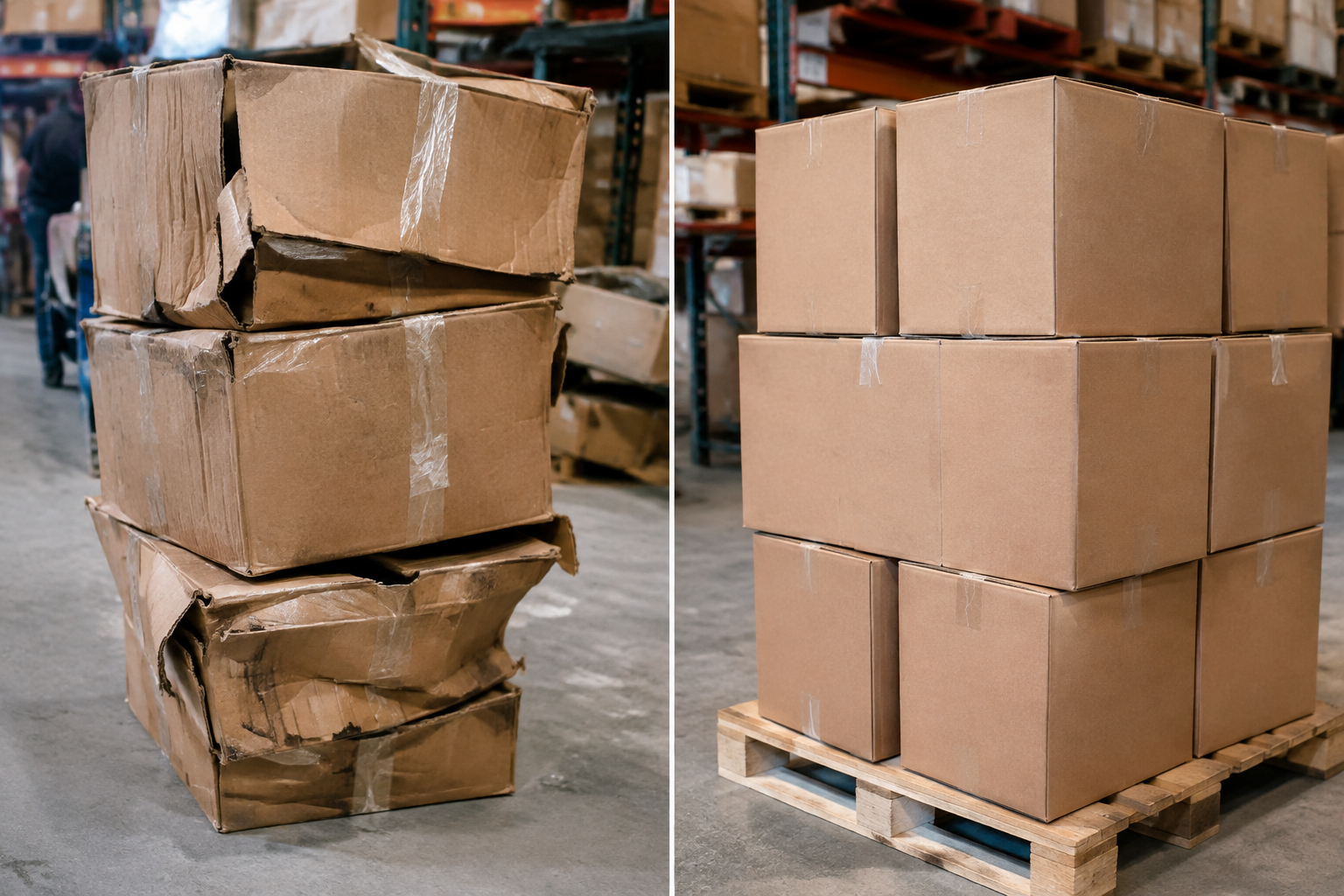
A box that survived one trip isn't the same box anymore. Packaging engineers say reused cardboard boxes can lose a large share of their stacking strength after a single shipping cycle, and most sellers never see it happen.
The damage hides in plain sight. Flutes get crushed along the corners. A scored fold line cracks, or humidity creeps in and softens the paper. The outside still looks fine, so the box goes back on the shelf, gets filled with product, and gets stacked under three more just like it.
Then comes the collapse. Usually it's a quiet slump on a bottom row, not a dramatic crash, and the first sign is a dented carton or a damage claim a week later.
Small ecommerce sellers shipping 50 to 1,000 orders a month are the most exposed. Free boxes from a retail store, leftover moving boxes, and recycled cartons from past orders all look like easy savings. Are they? The numbers on stacking strength suggest otherwise, and the cause comes down to how corrugated board is built, how it's rated, and what a used box has already been through.
Reused Cardboard Boxes Lose Stacking Strength After Just One Trip, Packaging Engineers Report
What Happened: The Core Finding on Reused Corrugated Strength Loss
A seller packs 300 orders into free grocery-store boxes, stacks the leftovers five high in a garage, and finds the bottom row crushed by Friday. That pattern is what packaging engineers keep reporting. A corrugated carton loses a large share of its edge crush strength once it has been shipped, opened, and flattened. Humidity, creased flutes, and torn liners do the damage. Often it's invisible. The box looks fine.
Engineers say a used carton can drop 30 to 60 percent of its original compression rating, depending on how it was handled. Stacked in storage, that gap shows up fast. Walls bow, corners fold — the load shifts.
Who Is Affected: Small Ecommerce Sellers Shipping 50 to 1,000 Orders a Month
Sellers at this volume are the most exposed. They're tempted to reuse boxes from moving, retail stores, or a nearby dumpster to save money. Many of them also store inventory in homes or small units, where stacks run tall for weeks.
-
Heavy items such as tools or bottled goods crush weak bottom boxes first.
-
Long storage lets damp air soften the paper.
-
Mixed sizes create uneven stacks that tip.
New cardboard boxes carry a known strength rating, so sellers can match the flute grade to the load. For very heavy goods, triple wall boxes hold up far better under a tall stack.
Background: How Edge Crush Test Ratings and Flute Grades Set Stacking Strength
Stacking strength comes from two specs, not looks. Edge crush rating and flute grade decide how much weight a carton can carry before the walls buckle, and both start to slip the moment a box gets reused.
ECT Ratings Explained in Plain Language
ECT stands for Edge Crush Test. A lab presses a small strip of corrugated board on its edge until it collapses, and the result is expressed in pounds per inch of edge. Common single wall grades run 32 ECT, 44 ECT and 48 ECT. Higher numbers mean the walls resist more top load. Every shipping cycle, though, crushes a few fibers, so a reused carton rarely tests at its printed number.
-
32 ECT: light items, short stacks.
-
44 ECT: general shipping, moderate stacks.
-
48 ECT and up: heavy-duty loads and tall pallets.
B-Flute, C-Flute and E-Flute: Which Holds Up Under Weight
Flute is the wavy layer between the liners. C-flute (about 3/16 inch) is the usual pick for stacking because its taller arches carry vertical load well. B-flute (1/8 inch) is flatter — denser, so it resists crushing from impact and prints cleanly. E-flute (1/16 inch) is thin, suited to small retail cartons like white cardboard boxes, and it isn't meant for tall stacks.
For storage, heavy products call for double wall boxes, which pair two flute layers for far greater compression strength. Used cardboard boxes in single-wall grades simply can't match that, especially after damp storage.
What Damage Does to Corrugated: Crushed Flutes, Moisture and Scored Fold Lines
Why Used Moving Boxes and Free Boxes Fail First at the Corners
Why do secondhand cardboard boxes give out at the corners before anywhere else? Because that's where the load actually travels. Corrugated carries stacking weight through its vertical flutes, and the corners and vertical edges hold most of it. Packaging engineers generally attribute the bulk of a box's compression strength to those edges.
Reuse wears them down fast. A box that's been taped, torn open, and dropped once or twice has crushed flutes along its edges. Crushed flutes can't stand upright anymore. Strength falls off, often by a third or more after a single prior trip, according to common packaging lab findings.
Free boxes carry the same problem. Grocery cartons, moving boxes from a garage, and boxes pulled from a back dock arrive with hidden damage:
-
Scored fold lines already cracked from the first flattening, so the flaps no longer hinge cleanly.
-
Moisture absorbed from damp storage, which softens the paper fibers and cuts stacking strength sharply.
-
Mixed flute grades and unknown ECT ratings, so nobody can say what load the box will hold.
For a small store stacking inventory, that's a gamble. Sourcing wholesale cardboard shipping boxes gives uniform flutes and clean corners. UCANPACK also offers free samples, so a sturdy box can be tested before a bulk order.
Warehouse Stacking Failures: Where Reused Boxes Collapse on Shelves and Pallets
Heavy Duty vs Single Wall: Matching Box Grade to Stack Height
A used box can lose up to 40% of its original stacking strength after a single trip. That figure comes from compression testing, and it explains why bottom-tier cartons fail first on pallets.
Single-wall corrugated rated at 32 ECT handles light loads.
Think apparel, paper goods, small accessories. Stack those five high with reused cartons on the bottom, and the bottom row starts to bow within weeks. Humidity speeds that up.
Heavy-duty double wall is a different animal. Packaging engineers typically point to 44 ECT or higher for pallets stacked past four tiers, or for any product weighing over 40 pounds per carton.
A simple matching rule works for most small stores:
-
1-3 tiers, under 20 lbs: new single wall, 32 ECT
-
4-5 tiers, 20-40 lbs: new single wall, 44 ECT
-
6+ tiers or over 40 lbs: double wall, heavy duty
Retail-grade protective cartons are a separate case. Lightweight SBS cardboard boxes suit shelf display and lighter inventory, but they aren't built for tall stacks.
So where do reused cardboard boxes fit?
Top of the pallet. Light items only. Never on the bottom row — never in damp storage.
Skip that discipline, and one crushed corner tips the whole stack.
Free and Secondhand Cardboard Boxes: Where They Come From and What They Cost You in Damage
Free boxes aren't free. That's the myth, and warehouse damage reports prove it wrong. A used carton has already lived one shipping cycle, and a corrugated wall that's been stacked, humid, or dropped once can lose roughly a third of its original stacking strength. Nobody sees it. The box looks fine.
Retail Store Boxes, Nearby Pickup and Free Shipping Boxes Compared
Small sellers usually grab boxes from three places. Each one carries a different risk.
-
Retail store castoffs: Grocery and big-box stores toss thousands daily, but they're built for produce or cereal, not for 40-pound stacks. Many are thin single-wall, and some carry food residue.
-
Nearby pickup: Moving boxes from neighbors or online listings are cheap to grab. Expect crushed corners, old tape scars, and unknown history.
-
Free shipping boxes: Carrier-supplied cartons are built for specific services, such as USPS Priority. They're sturdy enough for mail, yet using them for storage or other carriers can break service rules.
Here's what most people miss: shape matters too. Die-cut styles like pizza boxes are made for flat, light loads. Reusing them as heavy-duty storage cartons is a quick way to crush the bottom tier.
So what's the safe rule? Use secondhand boxes for light, short-term, top-of-stack loads only. Anything heavy, long-stored, or stacked three high deserves a fresh, rated carton. One collapsed pallet row costs far more than a bundle of new boxes.
What Packaging Experts and Sellers Say About Reuse, Damage Claims and Risk
A seller in a rented warehouse stacks twelve pallets of reused cardboard boxes five high. Three weeks later, the bottom tier has bowed, and the corners have split. Nobody dropped anything. The boxes simply gave out.
That story keeps showing up in packaging labs. Corrugated board loses strength every time it's folded, taped, peeled, and re-flattened. Packaging engineers generally point to a 30 to 40 percent drop in stacking strength after a single shipping cycle, and humidity makes it worse. Sellers rarely see the loss until a stack leans.
What sellers report
-
Crushed bottom-tier cartons on pallets stored longer than 30 days.
-
Damage claims from carriers that cite weak packaging as the cause.
-
Mixed flute grades in one stack, which creates uneven pressure.
Where reuse still works
Reused boxes hold up fine for light items, short-term storage, and low stacks. Heavy-duty goods and long-term racking are a different story. Here's the honest rule: if a box carries weight on top of it, buy it new.
Brand-conscious sellers have another option. Ordering custom mailer boxes in small runs gives full-strength board and a clean look, without tying up storage space. Free samples let a seller test fit and crush resistance before committing.
One failed claim can wipe out months of savings from reuse. Is that a fair trade?
Practical Steps: Choosing New Sturdy Boxes in Low Quantities and Right-Sizing Them
Ordering Small Bundles and Free Samples Before You Commit
Don't buy 500 boxes on a guess. That's the fastest way to end up with a garage full of the wrong size.
Small bundles of 25 to 50 units let a shop owner test new cardboard boxes against real orders. Most suppliers that cater to low-volume sellers offer free samples, and that's where the testing starts. Order two or three sizes, pack actual products, and see what happens.
Here's a simple routine that works for stores shipping 50 to 1,000 orders a month:
-
Measure each product's length, width, and height, then add 1 to 2 inches per side for cushioning.
-
Request a sample of each candidate size. Check the flute grade and the edge crush test (ECT) rating printed on the bottom flap.
-
Pack a real order, seal it, and drop it from about 3 feet onto a corner. Do it three times.
-
Stack ten packed samples and leave them for a week. Crushed bottoms mean the grade is too light.
Squarer products fit well in cube boxes, which also cut down on wasted filler. Most shops end up covering their whole range with just two or three sizes.
Sample first, then buy a small bundle. Only then scale up.
Outlook: What Small Sellers Can Expect Next for Box Standards and Reuse Rules
Will carriers start asking sellers to prove a box is new? Nobody has issued a formal ruling yet, but the direction is easy to read. Carriers already print a box certificate on the bottom flap, and that certificate assumes an intact, first-use carton.
Small sellers shipping 50 to 1,000 orders a month should expect tighter attention on three fronts:
-
Stacking and compression ratings. Edge crush (ECT) numbers are showing up on more product pages, and buyers are starting to ask for them.
-
Reuse labeling. Fulfillment centers increasingly flag worn, crushed-corner or damp cardboard boxes before they enter storage racks.
-
Right-sizing. Dimensional weight rules keep punishing oversized cartons, so sloppy fits cost more each year.
Here's the practical read. A reused carton that once held 40 pounds has lost a real share of its stacking strength, often quoted at 30 percent or more after one trip. That's why storage stacks collapse in the third tier, not the first.
So what should a small seller do now? Keep reused boxes for light, short-term, single-layer jobs. Buy fresh heavy duty shipping boxes for anything stacked, stored, or shipped heavy.
Ordering samples first helps. Test a carton with your actual product before committing to bulk. Standards are tightening, not loosening.
A box that's been used once isn't the box it was. Crushed flutes, damp spots, and cracked fold lines cut the weight a stack can carry, and the loss rarely shows until a pallet leans or a shelf lets go. Packaging engineers keep reporting the same pattern, and small sellers shipping 50 to 1,000 orders a month feel it first, usually as damage claims and refunds.
The fix is less dramatic than the problem.
Sellers who match flute grade and ECT rating to stack height, and who size boxes close to the product, avoid most failures before they start. Free secondhand cardboard boxes still work for light, short-term jobs. They don't belong under a load.
The next step is simple. Measure the three heaviest products in the catalog, note how high each one gets stacked in storage, and order a small bundle of new single-wall or double-wall boxes in the matching grade. Request free samples first, pack a real order into each, and press down on the closed lid. Whichever sample holds without flexing is the one to reorder.
UCANPACK
753A Tucker Rd
Winder, GA 30680
1 201-975-6272
https://ucanpack.com


