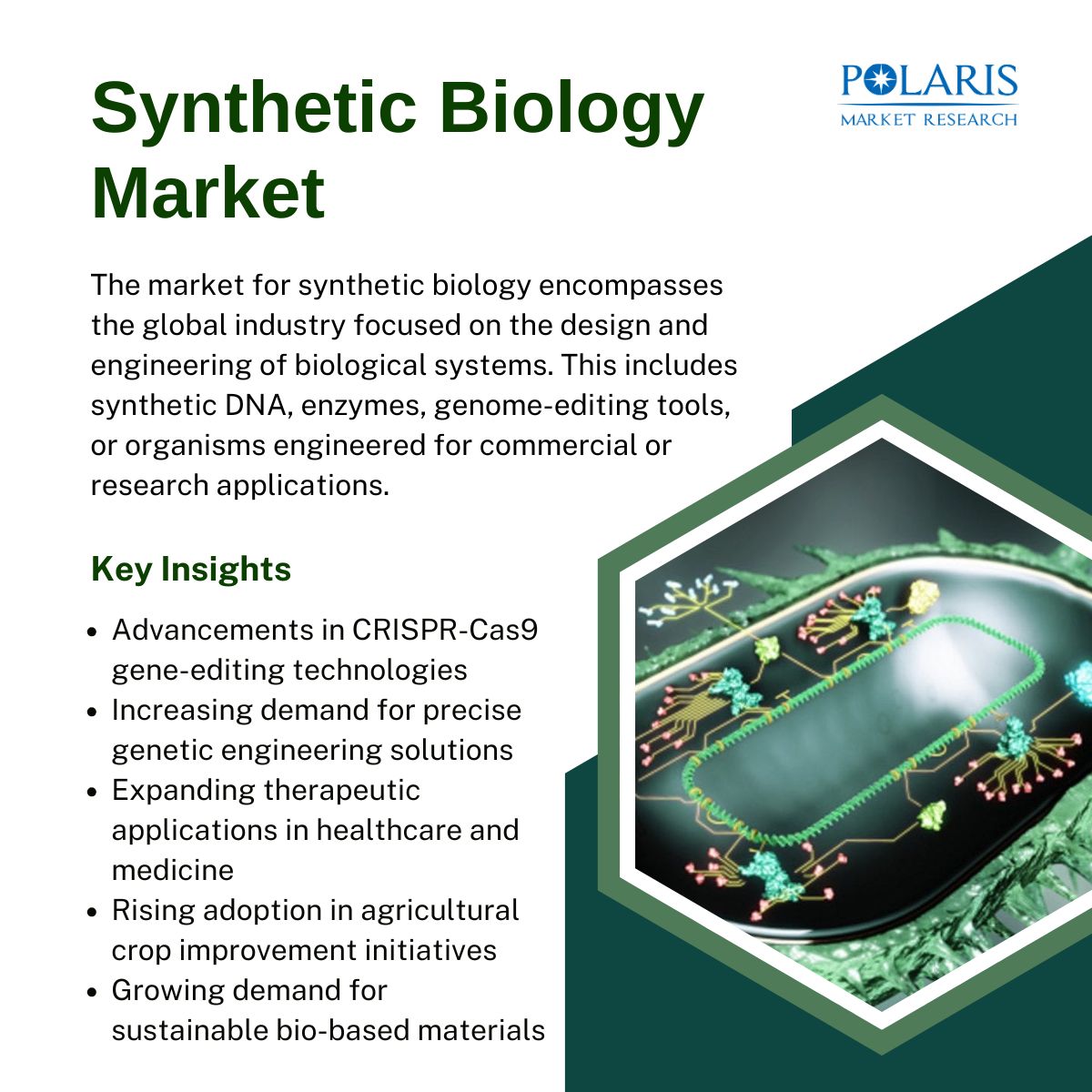
Synthetic Biology Market to Surpass USD 78.16 Billion by 2034 as Engineering Living Cells Becomes the New Industrial Revolution, Reveals Polaris Market Research
NEW YORK CITY, NY, UNITED STATES, June 9, 2026 /EINPresswire.com/ — 𝐏𝐨𝐥𝐚𝐫𝐢𝐬 𝐌𝐚𝐫𝐤𝐞𝐭 𝐑𝐞𝐬𝐞𝐚𝐫𝐜𝐡 𝐡𝐚𝐬 𝐩𝐮𝐛𝐥𝐢𝐬𝐡𝐞𝐝 𝐚 𝐧𝐞𝐰 𝐬𝐭𝐮𝐝𝐲 𝐨𝐧 𝐭𝐡𝐞 𝐒𝐲𝐧𝐭𝐡𝐞𝐭𝐢𝐜 𝐁𝐢𝐨𝐥𝐨𝐠𝐲 𝐌𝐚𝐫𝐤𝐞𝐭. 𝐀𝐜𝐜𝐨𝐫𝐝𝐢𝐧𝐠 𝐭𝐨 𝐭𝐡𝐞 𝐫𝐞𝐩𝐨𝐫𝐭, 𝐭𝐡𝐞 𝐦𝐚𝐫𝐤𝐞𝐭 𝐰𝐚𝐬 𝐯𝐚𝐥𝐮𝐞𝐝 𝐚𝐭 𝐔𝐒𝐃 𝟏𝟖.𝟕𝟑 𝐛𝐢𝐥𝐥𝐢𝐨𝐧 𝐢𝐧 𝟐𝟎𝟐𝟓 𝐚𝐧𝐝 𝐢𝐬 𝐞𝐱𝐩𝐞𝐜𝐭𝐞𝐝 𝐭𝐨 𝐫𝐞𝐚𝐜𝐡 𝐔𝐒𝐃 𝟕𝟖.𝟏𝟔 𝐛𝐢𝐥𝐥𝐢𝐨𝐧 𝐛𝐲 𝟐𝟎𝟑𝟒. 𝐈𝐭 𝐢𝐬 𝐞𝐱𝐩𝐞𝐜𝐭𝐞𝐝 𝐭𝐨 𝐫𝐞𝐠𝐢𝐬𝐭𝐞𝐫 𝐚 𝐂𝐀𝐆𝐑 𝐨𝐟 𝟏𝟕.𝟐% 𝐟𝐫𝐨𝐦 𝟐𝟎𝟐𝟔 𝐭𝐨 𝟐𝟎𝟑𝟒.
The rise of biological engineering, DNA synthesis, CRISPR-based gene editing, and AI-driven design is changing how living systems are built and used. The advances are helping industries move faster in pharmaceuticals, agriculture, specialty chemicals, materials science and consumer goods. The market is also getting a boost from rising research investment, bio-based product demand and larger use of synthetic DNA and genome editing tools.
𝗡𝗼𝘁𝗲: 𝗚𝗲𝘁 𝗶𝗻𝘀𝘁𝗮𝗻𝘁 𝗮𝗰𝗰𝗲𝘀𝘀 𝘁𝗼 𝘁𝗵𝗲 𝗿𝗲𝗽𝗼𝗿𝘁. 𝗪𝗲’𝗿𝗲 𝗵𝗮𝗽𝗽𝘆 𝘁𝗼 𝗱𝗶𝘀𝗰𝘂𝘀𝘀 𝘁𝗵𝗲 𝗸𝗲𝘆 𝗶𝗻𝘀𝗶𝗴𝗵𝘁𝘀 𝗮𝗻𝗱 𝗮𝗱𝗮𝗽𝘁 𝘁𝗵𝗲 𝗮𝗻𝗮𝗹𝘆𝘀𝗶𝘀 𝘁𝗼 𝘀𝘂𝗽𝗽𝗼𝗿𝘁 𝘆𝗼𝘂𝗿 𝘀𝘁𝗿𝗮𝘁𝗲𝗴𝗶𝗰 𝗱𝗲𝗰𝗶𝘀𝗶𝗼𝗻𝘀.
𝐌𝐚𝐫𝐤𝐞𝐭 𝐎𝐯𝐞𝐫𝐯𝐢𝐞𝐰 & 𝐒𝐞𝐠𝐦𝐞𝐧𝐭𝐚𝐭𝐢𝐨𝐧
Synthetic Biology Market Spans Seven Industries, and it is Disrupting Every One of Them
Synthetic biology is not limited to one industry. It is spreading across healthcare, agriculture, chemicals, materials, consumer products, and more. That wide reach is the main reason investors are paying close attention. Unlike many new technologies, it can influence several markets at the same time.
𝐌𝐚𝐫𝐤𝐞𝐭 𝐒𝐞𝐠𝐦𝐞𝐧𝐭𝐚𝐭𝐢𝐨𝐧
𝐁𝐲 𝐏𝐫𝐨𝐝𝐮𝐜𝐭: Oligonucleotide/Oligo Pools & Synthetic DNA, Enzymes, Cloning Technologies Kits, Xeno-Nucleic Acids, Chassis Organism
𝐁𝐲 𝐓𝐞𝐜𝐡𝐧𝐨𝐥𝐨𝐠𝐲: NGS Technology, PCR Technology, Genome Editing Technology, Bioprocessing Technology, Other Technologies
𝐁𝐲 𝐀𝐩𝐩𝐥𝐢𝐜𝐚𝐭𝐢𝐨𝐧: Healthcare, Non-Healthcare
𝐁𝐲 𝐑𝐞𝐠𝐢𝐨𝐧𝐚𝐥:
• North America: US, Canada
• Europe: Germany, France, UK, Italy, Spain, Netherlands, Russia, Rest of Europe
• Asia Pacific: China, Japan, India, Malaysia, South Korea, Indonesia, Australia, Vietnam, Rest of Asia Pacific
• Middle East & Africa: Saudi Arabia, UAE, Israel, South Africa, Rest of Middle East & Africa
• Latin America: Mexico, Brazil, Argentina, Rest of Latin America
𝐊𝐞𝐲 𝐌𝐚𝐫𝐤𝐞𝐭 𝐃𝐫𝐢𝐯𝐞𝐫𝐬
𝐅𝐨𝐮𝐫 𝐂𝐨𝐧𝐯𝐞𝐫𝐠𝐢𝐧𝐠 𝐅𝐨𝐫𝐜𝐞𝐬 𝐓𝐮𝐫𝐧𝐢𝐧𝐠 𝐒𝐲𝐧𝐭𝐡𝐞𝐭𝐢𝐜 𝐁𝐢𝐨𝐥𝐨𝐠𝐲 𝐅𝐫𝐨𝐦 𝐋𝐚𝐛 𝐂𝐮𝐫𝐢𝐨𝐬𝐢𝐭𝐲 𝐭𝐨 𝐚 𝐌𝐮𝐥𝐭𝐢-𝐁𝐢𝐥𝐥𝐢𝐨𝐧 𝐃𝐨𝐥𝐥𝐚𝐫 𝐂𝐨𝐦𝐦𝐞𝐫𝐜𝐢𝐚𝐥 𝐄𝐧𝐠𝐢𝐧𝐞
Synthetic biology is moving from a research topic to a commercial platform because four forces are pushing the market at the same time. AI, inexpensive DNA synthesis, sustainability goals, and government funding are making the field faster, wider, and more investable. These changes are pushing synthetic biology into more real world use.
• 𝐀𝐈 𝐚𝐧𝐝 𝐛𝐢𝐨𝐥𝐨𝐠𝐲 𝐜𝐨𝐧𝐯𝐞𝐫𝐠𝐞𝐧𝐜𝐞: AI is cutting down discovery time. It improves the way biological systems are designed. Tools like AlphaFold changed protein structure work. AI-designed genetic circuits are now entering pipelines. Biofoundry models allow companies run many design-build-test-learn cycles together, which saves time and helps development move faster.
• 𝐅𝐚𝐥𝐥𝐢𝐧𝐠 𝐃𝐍𝐀 𝐬𝐲𝐧𝐭𝐡𝐞𝐬𝐢𝐬 𝐜𝐨𝐬𝐭𝐬: The cost of producing synthetic DNA has fallen sharply over time. This has made it easier for startups and smaller research groups to enter the field. Lower costs are helping the DNA synthesis market to grow. The lower cost factor is enabling more synthetic biology applications.
• 𝐒𝐮𝐬𝐭𝐚𝐢𝐧𝐚𝐛𝐢𝐥𝐢𝐭𝐲 𝐦𝐚𝐧𝐝𝐚𝐭𝐞𝐬: Many firms are under pressure to cut emissions and reduce petrochemical use. Synthetic biology is supporting create bio based chemicals, fuels, plastics, textiles, and food ingredients through metabolic engineering pathways. This makes it useful for companies seeking cleaner production methods.
• 𝐆𝐨𝐯𝐞𝐫𝐧𝐦𝐞𝐧𝐭 𝐟𝐮𝐧𝐝𝐢𝐧𝐠 𝐬𝐮𝐫𝐠𝐞: Public funding is also giving the sector momentum. Programs in the US, Europe, and the UK are treating synthetic biology as an essential strategic area. That support is helping the biofoundry market grow and is encouraging scale up in the sector.
𝐀𝐩𝐩𝐥𝐢𝐜𝐚𝐭𝐢𝐨𝐧 𝐃𝐞𝐞𝐩-𝐃𝐢𝐯𝐞: 𝐖𝐡𝐞𝐫𝐞 𝐭𝐡𝐞 𝐌𝐨𝐧𝐞𝐲 𝐈𝐬 𝐁𝐞𝐢𝐧𝐠 𝐌𝐚𝐝𝐞
𝐅𝐫𝐨𝐦 𝐈𝐧𝐬𝐮𝐥𝐢𝐧 𝐭𝐨 𝐒𝐩𝐢𝐝𝐞𝐫 𝐒𝐢𝐥𝐤: 𝐒𝐲𝐧𝐭𝐡𝐞𝐭𝐢𝐜 𝐁𝐢𝐨𝐥𝐨𝐠𝐲 𝐀𝐩𝐩𝐥𝐢𝐜𝐚𝐭𝐢𝐨𝐧𝐬 𝐑𝐞𝐰𝐫𝐢𝐭𝐢𝐧𝐠 𝐭𝐡𝐞 𝐑𝐮𝐥𝐞𝐬 𝐨𝐟 𝐌𝐚𝐧𝐮𝐟𝐚𝐜𝐭𝐮𝐫𝐢𝐧𝐠
Move beyond abstract potential, buyers want to know where revenue is real today and where the next wave is building. In synthetic biology, that picture is getting clearer. Healthcare still brings in the largest share, while industrial biotechnology is gaining speed as companies push bio-based production into real manufacturing. Agriculture is also opening new commercial space as precision gene editing, engineered microbes, and alternative food ingredients move closer to wider adoption.
• 𝐇𝐞𝐚𝐥𝐭𝐡𝐜𝐚𝐫𝐞
Healthcare remains the largest area where synthetic biology is generating revenue today. Recombinant protein therapeutics like insulin and growth hormone already form a mature revenue stream. mRNA vaccine platforms also gave the field a major push, especially after COVID-19 outbreak accelerated biomanufacturing capacity worldwide. In cell therapy, synthetic gene circuits are being used to control immune cell behavior more precisely. Another area of interest is microbiome engineering, especially for gut health, oncology and rare metabolic diseases.
• 𝐈𝐧𝐝𝐮𝐬𝐭𝐫𝐢𝐚𝐥 𝐁𝐢𝐨𝐭𝐞𝐜𝐡𝐧𝐨𝐥𝐨𝐠𝐲
Industrial biotechnology is one of the fastest-growing non-pharma areas. Companies are using synthetic biology to produce bio-based nylon, spider silk proteins, and biodegradable plastics. Fermentation-based flavors and fragrances are also replacing older petrochemical methods in some products. Biofuels and sustainable aviation fuel precursors are being developed through metabolic engineering of yeast and algae. Another area of interest is cell-free synthetic biology which allows for rapid prototyping of industrial enzymes without the need for a live organism.
• 𝐀𝐠𝐫𝐢𝐜𝐮𝐥𝐭𝐮𝐫𝐞
Agriculture is another key use case. Synthetic biology is helping develop nitrogen-fixing microbes to reduce reliance on synthetic fertilizer. It is also being used in disease-resistant crop development through precision gene editing. Lab-grown food ingredients such as animal-free dairy proteins, egg proteins and fats are also becoming more visible in the market.
𝐂𝐨𝐦𝐩𝐞𝐭𝐢𝐭𝐢𝐯𝐞 𝐋𝐚𝐧𝐝𝐬𝐜𝐚𝐩𝐞
𝐒𝐲𝐧𝐭𝐡𝐞𝐭𝐢𝐜 𝐁𝐢𝐨𝐥𝐨𝐠𝐲 𝐂𝐨𝐦𝐩𝐚𝐧𝐢𝐞𝐬: 𝐀 𝐓𝐡𝐫𝐞𝐞-𝐓𝐢𝐞𝐫 𝐑𝐚𝐜𝐞 𝐁𝐞𝐭𝐰𝐞𝐞𝐧 𝐁𝐢𝐨𝐭𝐞𝐜𝐡 𝐆𝐢𝐚𝐧𝐭𝐬, 𝐏𝐥𝐚𝐭𝐟𝐨𝐫𝐦 𝐏𝐥𝐚𝐲𝐬, 𝐚𝐧𝐝 𝐃𝐞𝐞𝐩-𝐓𝐞𝐜𝐡 𝐒𝐭𝐚𝐫𝐭𝐮𝐩𝐬
The competitive landscape for synthetic biology is becoming more structured, and companies are moving in clear tiers. Established players are building the core infrastructure. Smaller firms are pushing faster innovation in narrow areas. This is also where synthetic biology companies are becoming more essential to pharmaceutical biotechnology.
• 𝐓𝐢𝐞𝐫 𝟏: Ginkgo Bioworks, Twist Bioscience, Illumina, and Thermo Fisher Scientific are the market leaders. Ginkgo is focused on horizontal platform model and biofoundry services. Twist offers synthetic DNA manufacturing at scale. Illumina supports sequencing. Thermo Fisher offers tools, reagents, and bioproduction systems.
• 𝐓𝐢𝐞𝐫 𝟐: High-growth companies include Zymergen, Synthego, Mammoth Biosciences, Absci Corporation, and Recursion Pharmaceuticals. These firms are active in gene editing, platform development, and data-driven biology.
• 𝐓𝐢𝐞𝐫 𝟑: Regional and specialist players are also growing. In China, companies such as BGI Genomics and SynBio Tech are building local strength. In Europe, names like Eligo Bioscience and Octarine Bio are gaining attention. In India, CSIR-backed programs are helping the field move forward.
M&A activity is also increasing. Large pharma and chemical companies are buying synbio platforms to secure bio-based supply chains and therapeutic pipelines.
𝐂𝐡𝐚𝐥𝐥𝐞𝐧𝐠𝐞𝐬, 𝐑𝐞𝐠𝐮𝐥𝐚𝐭𝐢𝐨𝐧 & 𝐁𝐢𝐨𝐬𝐞𝐜𝐮𝐫𝐢𝐭𝐲
𝐁𝐢𝐨𝐬𝐞𝐜𝐮𝐫𝐢𝐭𝐲, 𝐈𝐏 𝐂𝐨𝐦𝐩𝐥𝐞𝐱𝐢𝐭𝐲, 𝐚𝐧𝐝 𝐑𝐞𝐠𝐮𝐥𝐚𝐭𝐨𝐫𝐲 𝐔𝐧𝐜𝐞𝐫𝐭𝐚𝐢𝐧𝐭𝐲 𝐑𝐞𝐦𝐚𝐢𝐧 𝐭𝐡𝐞 𝐌𝐚𝐫𝐤𝐞𝐭’𝐬 𝐓𝐡𝐫𝐞𝐞 𝐏𝐫𝐞𝐬𝐬𝐮𝐫𝐞 𝐏𝐨𝐢𝐧𝐭𝐬
Synthetic biology is growing fast, but it still faces a few important pressure points. Biosecurity, regulation, and scale-up costs continue to shape how quickly the market can expand. These issues are important for both developers and buyers, especially in the industrial biotechnology market.
• 𝐑𝐞𝐠𝐮𝐥𝐚𝐭𝐨𝐫𝐲 𝐟𝐫𝐚𝐠𝐦𝐞𝐧𝐭𝐚𝐭𝐢𝐨𝐧: There is no single global rulebook for synthetic organisms. In the US, oversight is split between the FDA, EPA and USDA. This can complicate compliance for new companies. In Europe, rules around contained use and deliberate release add further complexity.
• 𝐁𝐢𝐨𝐬𝐞𝐜𝐮𝐫𝐢𝐭𝐲 𝐫𝐢𝐬𝐤𝐬: DNA synthesis supports create useful products, but it also has dual use concerns. The same tools used for medicines can also be misused. That’s why screening standards and export controls are becoming tighter.
• 𝐁𝐢𝐨𝐞𝐭𝐡𝐢𝐜𝐬 𝐚𝐧𝐝 𝐩𝐮𝐛𝐥𝐢𝐜 𝐩𝐞𝐫𝐜𝐞𝐩𝐭𝐢𝐨𝐧: Consumer acceptance is still uneven. The issue is especially important for synbio-derived food ingredients. This is a bigger concern in Europe and parts of Asia, where labeling and safety debates continue.
• 𝐒𝐜𝐚𝐥𝐞-𝐮𝐩 𝐞𝐜𝐨𝐧𝐨𝐦𝐢𝐜𝐬: Scale up from lab to manufacturing is still expensive and uncertain. Optimization of fermentation yield is still a major bottleneck for industrial biotechnology.
𝐑𝐞𝐠𝐢𝐨𝐧𝐚𝐥 𝐀𝐧𝐚𝐥𝐲𝐬𝐢𝐬
𝐍𝐨𝐫𝐭𝐡 𝐀𝐦𝐞𝐫𝐢𝐜𝐚 𝐋𝐞𝐚𝐝𝐬 𝐈𝐧𝐧𝐨𝐯𝐚𝐭𝐢𝐨𝐧; 𝐀𝐬𝐢𝐚-𝐏𝐚𝐜𝐢𝐟𝐢𝐜 𝐑𝐚𝐜𝐞𝐬 𝐭𝐨 𝐂𝐥𝐨𝐬𝐞 𝐭𝐡𝐞 𝐆𝐚𝐩 𝐖𝐢𝐭𝐡 𝐌𝐚𝐬𝐬𝐢𝐯𝐞 𝐒𝐭𝐚𝐭𝐞 𝐈𝐧𝐯𝐞𝐬𝐭𝐦𝐞𝐧𝐭
North America leads the synthetic biology market, while Asia-Pacific is growing the fastest as countries increase investment in biotech and manufacturing.
• 𝐍𝐨𝐫𝐭𝐡 𝐀𝐦𝐞𝐫𝐢𝐜𝐚 commands global revenue and leads the market. The US is home to 60%+ of the top synthetic biology companies, and funding support from programs like Living Foundries and NIH continues to keep the innovation pipeline active. Canada is also emerging as a strong biotech hub, especially in the Toronto-Waterloo corridor.
• 𝐄𝐮𝐫𝐨𝐩𝐞 is building strength in industrial biotech. Germany, the UK, and the Netherlands are leading activity. EU help for the Green Deal Industrial Plan is supporting push the move toward bio-based chemicals. Both of these are helping support that shift. The UK is also treating synthetic biology as a strategic capability after Brexit.
• 𝐀𝐬𝐢𝐚-𝐏𝐚𝐜𝐢𝐟𝐢𝐜 is the fastest-growing region. China is investing aggressively in domestic DNA synthesis and genomics capacity. Singapore is growing as a regional hub through Biopolis. Japan is aiming more on fermentation based industrial uses.
• 𝐋𝐚𝐭𝐢𝐧 𝐀𝐦𝐞𝐫𝐢𝐜𝐚 and MEA are still early in development, but agricultural biotechnology is helping shape the market there.
𝐀𝐛𝐨𝐮𝐭 𝐭𝐡𝐞 𝐑𝐞𝐩𝐨𝐫𝐭
Access the latest Synthetic Biology Market intelligence report published by Polaris Market Research. The study covers revenue forecasts across major segments, technologies, applications, and geographies, along with analysis of growth drivers such as genome editing, sustainable biomanufacturing, drug discovery, and personalized medicine.
It also outlines opportunities linked to bio-based alternatives, food innovation, and AI-driven biological engineering, making it useful for biotech investors, pharmaceutical strategists, industrial chemical companies, and government science stakeholders tracking this fast-moving market
“Need custom synthetic biology market intelligence for your specific application or geography? Talk with a Polaris analyst today.”
Likhil G
Polaris Market Research and Consulting
+1 929-297-9727
email us here
Visit us on social media:
LinkedIn
Legal Disclaimer:
EIN Presswire provides this news content “as is” without warranty of any kind. We do not accept any responsibility or liability
for the accuracy, content, images, videos, licenses, completeness, legality, or reliability of the information contained in this
article. If you have any complaints or copyright issues related to this article, kindly contact the author above.

Media gallery