The Aldo Leopold Foundation discovers the land ethic in action in the legacy city of Cleveland
CLEVELAND, OH, UNITED STATES, June 22, 2026 /EINPresswire.com/ — For many, childhood means tire swings, backyard forts, and trees planted with grandparents. For others, the outdoors is an environment too unsafe to enter. That contrast stayed with Dr. Kristen Berg, a social scientist with The MetroHealth System at Case Western Reserve University School of Medicine, and helped shape her work connecting land, neighborhood conditions, and health. “The realization hit me in college while preparing a presentation on green spaces and health,” Berg says. “I realized access to outdoor play wasn’t equitably distributed. That reflection became a mission to understand how our environment contributes to human health.”
This mission—which mirrors the Aldo Leopold Foundation’s goal of fostering an ethical relationship between people and the land—now aligns with MetroHealth’s work across Cuyahoga County. As the county’s safety net health system, MetroHealth sees how recurring health issues are shaped not only by medical care, but also by the human-made, social, and physical environments where people live.
In Cleveland, those connections are visible in the city’s landscape. Several East Side neighborhoods have faced generations of environmental and social disinvestment, conditions that continue to shape health outcomes today. The polluted Cuyahoga River—dividing the city’s East and West sides—became a national symbol of environmental injustice after the 1969 river fire helped spark the U.S. environmental movement.
Decades later, the 2008 foreclosure crisis added another layer to that history of disinvestment. Residents were forced to leave their homes, and in time the vacant structures deteriorated, and many were demolished. Today, Cleveland has 30,000 vacant parcels, including 20,000 in public purview.
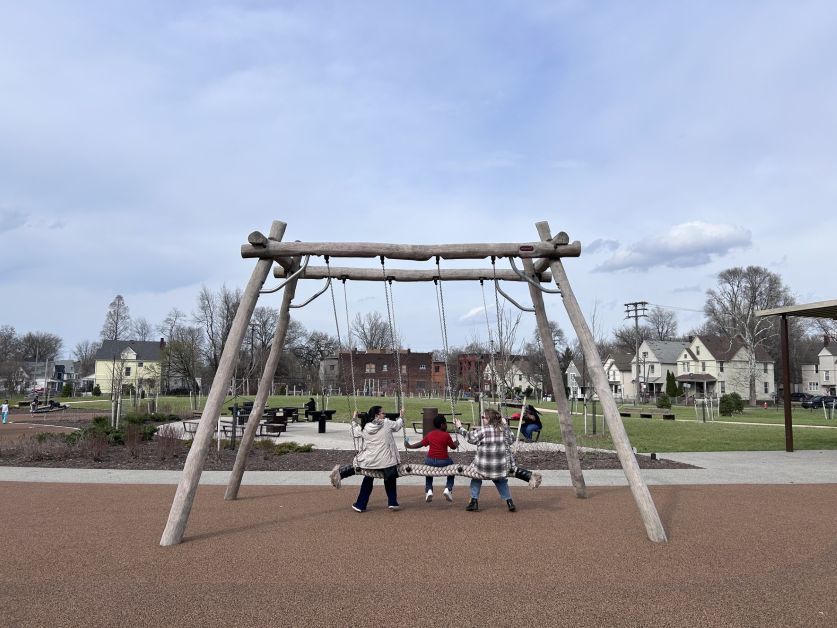
Rather than seeing vacant land only as evidence of loss, local leaders are treating it as a place to rebuild connection, safety, and neighborhood pride. Across Cleveland, residents are becoming co-creators and stewards of new green spaces designed to support stronger, healthier communities.
Pastor Ernest Fields of Calvary Hill Church of God in Christ has led revitalization in Buckeye-Woodhill, focusing on both the physical environment and residents’ professional growth. With local government, Greater Cleveland Habitat for Humanity, and the Western Reserve Land Conservancy (WRLC), the neighborhood now includes new green spaces and 40 newly constructed homes.
The work also emphasizes stewardship. “We are committed to mowing the city-owned vacant lots on a more regular basis,” says Pastor Fields. “Our goal is to have all five streets manicured and looking good, and we are encouraging the neighbors to get involved. We are working in community.”
This neighborhood-level work is also helping to shape a broader effort to understand how land restoration affects health. In 2024, WRLC received a $2.4 million federal grant from the U.S. Department of Health and Human Services to partner with MetroHealth, Cleveland Clinic, and Case Western Reserve University. The collaboration links healthcare and conservation data to measure short- and long-term health benefits in historically disinvested neighborhoods.
The effort combines WRLC’s expertise in urban reforestation, land transactions, and environmental remediation with neighborhood-level research and health evaluation. Expected benefits include cleaner air and reduced chronic disease.
For WRLC, that work reflects a broader land ethic rooted in relationship and responsibility. “Wherever you are from, wherever you live, your relationship to that place and that land may be very different—how you use it, how you recreate with it, how you move through it. But we all have a relationship with the land,” says Isaac Robb, WRLC’s Chief Urban Program Officer.
Residents at the center of this work, including those in Buckeye-Woodhill, are seeing the shift firsthand. They say “cleaning and greening” makes the area feel safer and helps the community “tie together” through shared ownership. In the years ahead, Dr. Berg’s evaluation team will study whether data supports what residents already feel: that land itself can be powerful medicine.
Andy Radtke
Aldo Leopold Foundation Inc
+1 608-606-1005
email us here
Legal Disclaimer:
EIN Presswire provides this news content “as is” without warranty of any kind. We do not accept any responsibility or liability
for the accuracy, content, images, videos, licenses, completeness, legality, or reliability of the information contained in this
article. If you have any complaints or copyright issues related to this article, kindly contact the author above.

Media gallery