Efficiency regulations, replacement demand, and Asia-Pacific penetration gains drive the global washing machine industry toward USD 102.5 billion by 2035.
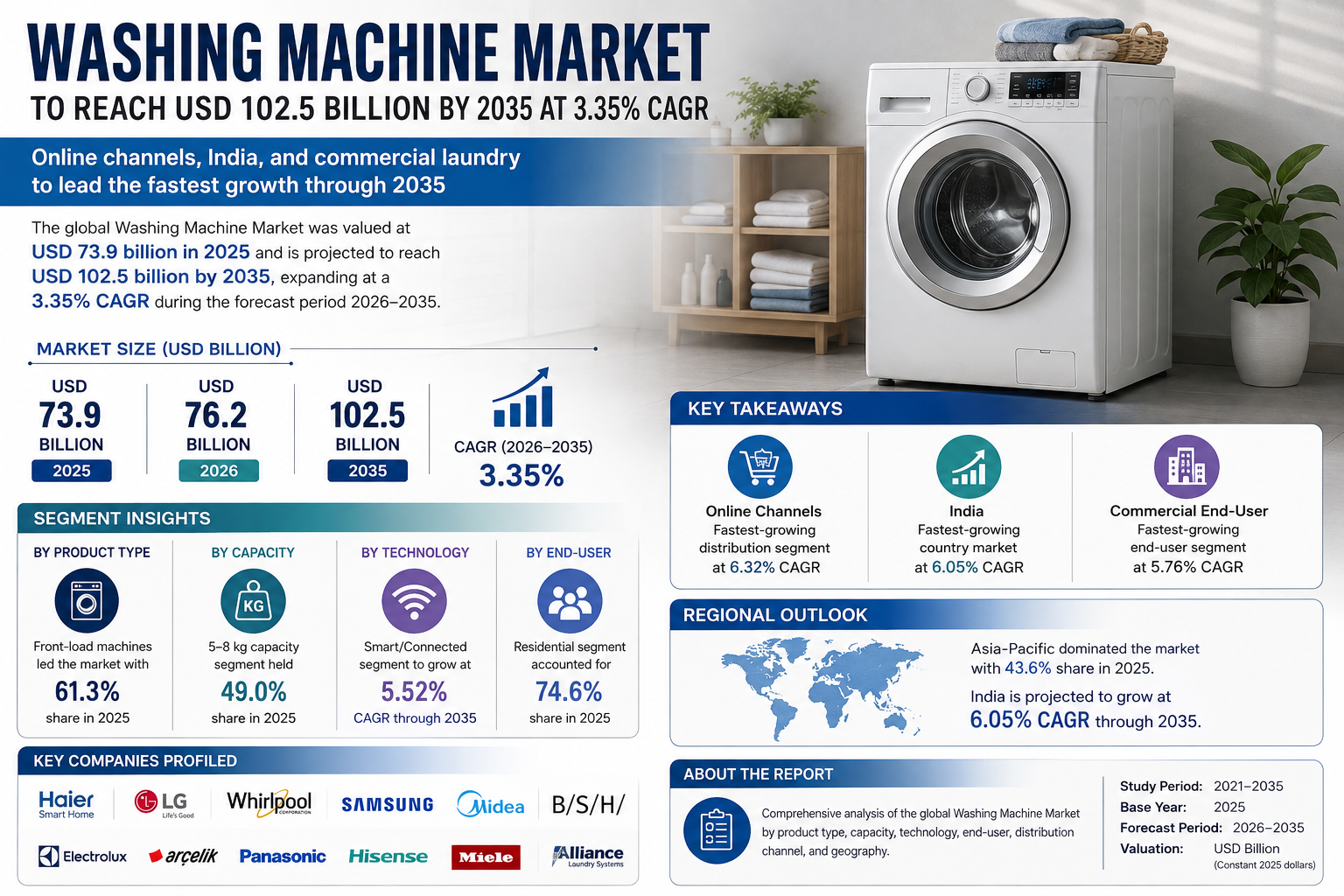
NEW YORK, NY, UNITED STATES, August 27, 2026 /EINPresswire.com/ — The global Washing Machine Market is on a steady, regulation-anchored growth path, with its valuation projected to climb from USD 73.9 billion in 2025 to USD 102.5 billion by 2035, registering a compound annual growth rate (CAGR) of 3.35% across the forecast period 2026–2035. The market enters the current forecast window at USD 76.2 billion in 2026, according to a new report from Market Research Future (MRFR), which frames the coming decade as one shaped less by first-time purchases and more by replacement cycles, efficiency compliance, and the migration of intelligence from flagship products into mainstream price tiers.
Two catalysts anchor this trajectory. The U.S. Department of Energy’s revised conservation standards for residential clothes washers, finalized in 2024, push manufacturers toward higher Integrated Modified Energy Factor thresholds and are projected to deliver an estimated USD 3.5 billion in lifetime consumer utility savings. In parallel, China’s expanded consumer goods trade-in programme allocated more than CNY 150 billion in 2025 to appliance replacement subsidies, pulling forward demand that would otherwise have remained idle. Together, these two forces illustrate a market increasingly driven by policy design rather than discretionary spending alone.
Market Overview: Replacement, Not First-Purchase, Drives Value
The washing machine industry sits at the intersection of household appliance manufacturing, energy and water regulation, and connected-device technology. As mature economies grapple with aging appliance fleets and emerging economies close the gap on basic ownership, the industry’s 3.35% CAGR through 2035 reflects steady, structural demand rather than a short-term replacement spike.
Mechanical timer platforms and single-speed induction motors are giving way to inverter-driven direct-drive systems equipped with load-sensing algorithms, automatic dosing, and tariff-aware cycle scheduling. The European Union’s Ecodesign framework, which mandates spare-part availability for a minimum of ten years, has quietly reshaped bill-of-materials decisions across the category and shifted margin toward service revenue rather than hardware sales alone.
Regionally, Asia-Pacific commands 43.6% of global value, supported by household formation and rapid online penetration, and it is also the fastest-growing region at 3.63% CAGR through 2035. Europe follows at 22.4% share, where efficiency labelling and microfibre filtration rules keep replacement cycles short. North America ranks third at 21.8% share, carried by premium product mix rather than raw unit volume. Industry analysts note that the next decade will reward manufacturers who convert compliance obligations into differentiated product architecture rather than treating regulation purely as a cost center.
Get Full PDF Sample Copy of Report: (Including Full TOC, List of Tables & Figures, Chart) @ https://www.marketresearchfuture.com/sample_request/12408
Market Segmentation: Efficiency, Capacity, and Channel Shifts
The Washing Machine Market report segments the industry across product type, capacity, technology, end-user, distribution channel, and geography.
By Product Type, front-load units held 61.3% share in 2025, retaining leadership on measurable water and detergent efficiency and stronger performance under nearly every major labelling regime. Top-load platforms, however, are forecast to expand faster, at a 4.94% CAGR through 2035, as value-conscious buyers in North America and Asia weigh shorter cycle times and lower entry pricing. Twin-tub machines remain an important affordability tier, valued at USD 6.1 billion in 2025, concentrated in emerging and rural markets where fully automatic platforms remain out of reach for many households.
By Capacity, the 5–8 kg band held 49.0% share in 2025 and remains the volume core of the market, doubling as the reference class for most regulatory test protocols. Below-5 kg units, valued at USD 14.2 billion, serve single-person households and compact housing formats, while above-8 kg machines are the fastest-growing capacity tier at a 4.12% CAGR, reflecting a broader household behavior of consolidating wash frequency into fewer, larger loads.
By Technology, conventional machines held 65.6% share in 2025 on the strength of price accessibility and service simplicity, but smart and connected models are the clear growth engine of the market, expanding at a 5.52% CAGR. Connectivity is shifting from a flagship differentiator to a mid-tier expectation, converting one-time buyers into addressable, serviceable accounts for manufacturers.
By End-User, residential applications accounted for 74.6% of 2025 demand, driven by global housing completions and stable replacement cycles. Commercial and on-premise laundry, however, is the fastest-growing end-user segment, expanding at a 5.76% CAGR through 2035 on the back of hospitality, healthcare, and multifamily housing demand.
By Distribution Channel, B2C retail led with 70.3% share in 2025, while offline specialty and multi-brand outlets generated USD 30.1 billion on the strength of in-person demonstration, financing options, and local service relationships. Online channels represent the fastest-growing distribution route, expanding at a 6.32% CAGR, as retailers increasingly bundle delivery, installation, and old-unit haul-away to close the gap that has historically kept bulky appliances offline. B2B and institutional purchasing, valued at USD 21.9 billion in 2025, continues to be driven by property developers and hospitality procurement.
Key Trends Shaping the Market Through 2035
Efficiency Regulation as a Refresh Trigger. Regulation increasingly functions as an unofficial product roadmap. The U.S. Department of Energy’s 2024 standards for residential clothes washers raise minimum performance thresholds effective 2028 and are estimated to cut national energy consumption by 0.16 quads over thirty years. Europe’s parallel Ecodesign framework already requires an energy-label scale under which fewer than 12% of listed models qualify for the top two efficiency classes, compelling manufacturers to redesign motor and drum architecture rather than rely on legacy platforms.
Household Formation and Penetration Headroom. Ownership across rural India and much of ASEAN remains below 45% of households, compared with more than 92% in Western Europe. Every percentage point of penetration gain in India alone represents an estimated 3.1 million incremental units, and rising female labor-force participation combined with shrinking average household size compounds this multi-decade opportunity.
Premiumization Through Sensing and Automation. Automatic dosing, turbidity sensing, and load-weight detection have migrated from flagship models into mid-tier product lines within roughly four years. Connected models now carry an average selling price premium of 22–28% along with materially higher accessory and detergent-partnership revenue, making connectivity attach rates as commercially important as headline unit pricing.
Subscription and Appliance-as-a-Service Models. Institutional purchasers increasingly favor per-cycle billing over outright capital purchase. Managed-laundry contracts across multifamily buildings, under which the operator retains hardware ownership and monetizes uptime, are expanding, locking in parts consumption and smoothing revenue for manufacturers and service providers alike.
Data Monetization from Connected Fleets. Cycle telemetry is enabling predictive service scheduling, detergent restocking partnerships, and demand-response participation with utilities in markets such as California and Germany, where washing is regarded as one of the most deferrable household loads, opening a recurring revenue line from the installed base.
Microfibre Filtration as a Compliance Product Category. France’s requirement under the AGEC framework for integrated microfibre filtration on new domestic machines has created a defined, testable feature specification. Suppliers that certify early are positioned to gain shelf advantage across the European Union as similar rules propagate to other member states.
Competitive Landscape: Low Concentration, Regional Champions
The global Washing Machine Market remains fragmented relative to many appliance categories, with an estimated Herfindahl-Hirschman Index in the 750–850 range and the top five suppliers holding roughly 52–58% of global value. Regional champions retain durable positions — Arçelik and BSH Hausgeräte in Europe, Midea Group and Haier Smart Home in China, and Whirlpool Corporation in North America — preventing any single competitor from consolidating global share.
Twelve global and regional manufacturers are profiled in the underlying report, led by Haier Smart Home (including GE Appliances), estimated at 13–16% revenue share on the strength of the broadest global footprint and a multi-brand regional strategy; LG Electronics, at an estimated 11–14% share, distinguished by direct-drive inverter technology and AI-based cycle sensing; Whirlpool Corporation, at 9–12% share, anchored by North American scale and service network depth; and Samsung Electronics, at 9–11% share, competing on connected laundry platforms and combination units. Midea Group, BSH Hausgeräte, Electrolux AB, Arçelik, Panasonic Corporation, Hisense Group, Miele & Cie. KG, and Alliance Laundry Systems round out the competitive set, spanning value-tier manufacturing scale, European repairability leadership, and pure-play commercial laundry systems.
Competitive intensity centers on efficiency certification, service network depth, and platform interoperability rather than price alone, reflecting the extent to which regulation and connectivity — rather than headline specifications — now define competitive advantage in the category.
Regional Dynamics
Asia-Pacific led the market with a 43.6% share in 2025 and is expected to remain the fastest-growing region at 3.63% CAGR through 2035. China, accounting for 44.5% of regional value, is being reshaped by trade-in subsidies steering buyers toward higher-efficiency inverter models eligible for larger rebate tiers. India stands out as the fastest-growing major country market at a 6.05% CAGR, driven by penetration gains and a tightening star-labelling framework from the Bureau of Energy Efficiency that is accelerating the shift from semi-automatic to fully automatic platforms.
Europe generated USD 16.6 billion in 2025 revenue and continues to be shaped by Ecodesign compliance, extended repairability mandates, and country-specific rules such as France’s microfibre filtration requirement. Germany, at 21.6% of regional share, leads on premium brand density and heat-pump adoption, while the United Kingdom’s right-to-repair regulations are extending average appliance lifecycles by an estimated 1.5 to 2.5 years.
North America held 21.8% global share in 2025, with the United States accounting for 78.4% of regional value on the strength of Department of Energy efficiency standards layered with utility rebates of USD 50–150 per unit. Mexico, growing at a 4.28% CAGR, plays a dual role as both a fast-growing consumption market and a critical nearshoring assembly hub.
South America, led by Brazil at 58.6% of regional share, is shaped more by credit availability than income levels, with installment plans stretching to eighteen months making mid-tier automatic machines accessible to a broader consumer base. Middle East & Africa is forecast to grow at a 3.41% CAGR, supported by housing programme completions in Saudi Arabia and hospitality-driven commercial laundry demand across the Gulf.
Market Drivers, Opportunities, and Restraints
Structural drivers include tightening global energy and water efficiency standards, urban household formation across Asia-Pacific and the Middle East & Africa, an aging installed base in North America, Europe, and Japan driving replacement demand, and continued premiumization through sensor-driven platforms. Government trade-in and appliance subsidy programmes in China, India, and the European Union are providing a nearer-term lift, while omnichannel and e-commerce expansion is reshaping how bulky appliances reach consumers.
Emerging opportunities extend beyond core hardware sales, including appliance-as-a-service and subscription billing models for institutional buyers, data monetization from connected appliance fleets through demand-response and predictive service partnerships, and localized entry-tier manufacturing across Africa, South Asia, and South America that can reduce landed costs by an estimated 9–14%. Compact, heat-pump-enabled washer-dryer combination units are also gaining share in dense urban housing markets across Japan, South Korea, and Western Europe.
At the same time, the industry faces real restraints. Price sensitivity and extended ownership cycles continue to temper replacement velocity globally, while raw material and freight cost volatility — particularly for steel, copper, and rare-earth magnets — pressures thin category margins. Tariffs and trade friction affecting finished appliances in North America and Europe, continued laundromat substitution in lower-income markets, and right-to-repair frameworks that extend appliance lifecycles all work to moderate the pace of replacement-driven growth over the coming decade.
Outlook
With the market projected to grow from USD 73.9 billion in 2025 to USD 102.5 billion by 2035, the global Washing Machine Market is positioned for a decade of steady, regulation- and replacement-driven expansion rather than dramatic volume surges. Manufacturers that successfully translate efficiency compliance into differentiated product architecture, extend service and aftermarket revenue streams, and scale connected, sensor-driven platforms into mainstream price tiers are best positioned to capture disproportionate share of this expanding market. As online channels, commercial laundry demand, and Indian household penetration lead category growth, the washing machine industry is set to evolve from a hardware-centric business into one increasingly defined by service economics, data, and compliance-driven innovation.
Discover Related Research Reports By Market Research Future:
Waterless washing machines Market
https://www.marketresearchfuture.com/reports/waterless-washing-machines-market-12139
Mini Washing Machine Market
https://www.marketresearchfuture.com/reports/mini-washing-machine-market-12301
US Washing Machine market
https://www.marketresearchfuture.com/reports/us-washing-machine-market-20995
Market Research Future
Market Research Future
+1 855-661-4441
email us here
Legal Disclaimer:
EIN Presswire provides this news content “as is” without warranty of any kind. We do not accept any responsibility or liability
for the accuracy, content, images, videos, licenses, completeness, legality, or reliability of the information contained in this
article. If you have any complaints or copyright issues related to this article, kindly contact the author above.

Media gallery